


Automate your Tableau Performance Testing with Wiiisdom for Tableau
Introduction
Testing the performance of your Tableau Server dashboards is critical to ensure people have the best possible user experience. Our solution, Wiiisdom for Tableau, allows you to load test your Tableau Server dashboards and measure response time and availability by driving actual load to your Tableau Server. It ensures your dashboard load time meets the SLAs (service level agreements) to meet business requirements. This article will explain how to perform performance testing using the Wiiisdom for Tableau desktop solution and some of the most common use cases.
Wiiisdom for Tableau Performance Testing
Performance testing your dashboards using Wiiisdom for Tableau performs actual user load to your Tableau Server/Cloud and assesses response time and availability. Wiiisdom for Tableau allows you to simulate a number of concurrent users and workbooks, combining the number of concurrent users accessing multiple views in a random fashion. The events used to run the dashboard performance include logging in, rendering a published view, and closing the dashboard.
To measure the performance of your Tableau dashboards, Wiiisdom for Tableau uses the Apdex Score to measure the actual user experience. The Apdex Score combines a Performance goal and an Availability goal to measure the Tableau Server’s ability to render published views within a Service Level Agreement.
Wiiisdom doesn’t just open a page, it replicates the entire user experience. For every virtual user, it launches a real browser session, logs in with credentials, and navigates through dashboards exactly as a human would. This allows performance measurement across all interactions: rather than only timing the initial page load, Wiiisdom captures the latency and responsiveness of every action such as filter changes, drill-downs, and dashboard navigation, switching parameters, …
Implementing a Performance Test in Wiiisdom for Tableau
Wiiisdom for Tableau desktop lets you choose the visualization(s) you’d like to test as well as the duration and the number of concurrent users. Then, you need to set your goals:
- Acceptable Performance response time
- Availability goal: this is your minimum availability acceptance, by default in Wiiisdom for Tableau, it’s 99.5% (total number of successful responses from Tableau Server compared to the total number of requests)
- Apdex score: by default in Wiiisdom for Tableau, this is 0.85
Once the execution of the test is completed, Wiiisdom for Tableau provides a full report for each view tested with multiple sections:
- Apdex: provides an overall score and then a score for each individual event
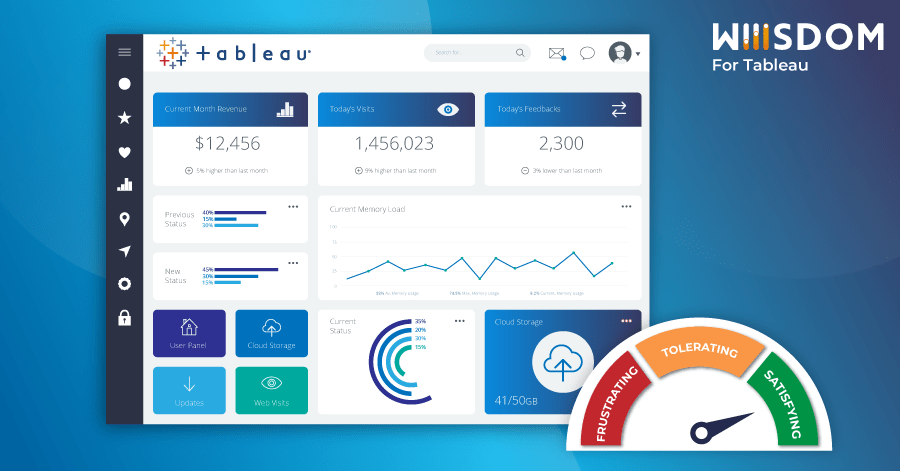
- Response time: shows the different levels of response, eg, frustrating, tolerating, satisfying
- Availability: finds any unsuccessful API response from Tableau Server. The performance test measures any API response that is not code 200 “OK” from the Tableau Server/Cloud. You can have code 429 which means “too many requests” or code 500 “internal server error”
- Sample log: displays all the measures Wiiiisdom for Tableau took for performance testing
NB: To further automate the process, you can configure a notification system, using Slack for example.


Once set up, those tests can of course be reused on a regular basis to ensure proper monitoring of performances over time. The scheduling of those tests can be executed by an external scheduler (for example, Windows Task Scheduler, Cron, Jenkins, etc).
Use Cases
Here are some of the most common use cases our customers are leveraging Wiiisdom for Tableau performance testing:
Anticipate Performance Issues
“I’m presenting a dashboard to a client and I need to make sure it refreshes quickly. This customer pays me more than $1000 a day and I can’t afford to not have access to data quickly and have a dashboard that doesn’t filter properly.”
As a user, there is nothing more frustrating than waiting forever for a dashboard to load to access the data that matters to them. Although it may be slower due to a poorly designed dashboard, it might also be slow because Tableau Server is underperforming. Load testing with Wiiisdom for Tableau would identify this. Slow performance is generally the number one complaint among users. You can discover the basics of Tableau dashboard performance in our blog.
Ensure A Successful Upgrade Or Migration
“My company just updated its Tableau Server version and the platform was definitely faster before.”
Changes happen over time, so you may need to update your Tableau Server and Desktop versions, your datasources, or even the OS server and architecture, and these changes might have an impact (positive or negative) on your end user experience. In order to switch from a user’s mentality of ‘it was faster before’ to real metrics (e.g. time to open a view), measuring your dashboard performance and comparing it over time is critical.
Ensure SLA Requirements are met
“The dashboards need to open within 5 seconds in order to abide by the SLAs put in place.”
Dashboard validations are not only about data quality, usability, and availability. For future dashboards, before they go live, one of the quality criteria should be that they meet the company’s SLAs, if not, the developers and data analysts should review the way they manage and present data.
Enhance Lifecycle Management
“I can’t risk delivering a new version of a dashboard to production without making sure every element has been thoroughly tested.”
Performance testing should be part of your CI/CD pipeline so that you can be sure that any dashboard pushed to production has been fully tested. Whenever a new dashboard is designed, it’s important that you exchange with the business about performance SLAs and testing scenarios to properly leverage the CI/CD framework. Ensure dashboards are designed to only extract necessary data from your data source because the more you extract the more time it may take to render the view. This needs to be a design criteria and best practice when it comes to performance testing.
Ensure Optimal Embedded Analytics
“All the retail stores in my territory close at the same time and employees will access their Tableau dashboards to see the performances of the day at the same time.”
Tableau performance testing will ensure your platform can handle the sudden load of users in real-life conditions so that you can maintain the best user experience possible.
Summary
Wiiisdom for Tableau performance testing ensures an optimal user experience by simulating user activity and peaks so that people can access their dashboards in a timely manner defined by an SLA. Ultimately, Tableau performance testing ensures SLAs are monitored and documented which in time needs to become part of a company’s culture. If you’re interested in putting performance testing in place for your Tableau dashboards, get in touch with us.
